Table of Contents
Abstract#
Norwegian Defence Research analysis of how voluntary organisations like Red Cross and People’s Aid can strengthen total defence, finding significant but underutilised resources requiring better coordination frameworks.
Summary#
Commissioned by Norske Kvinners Sanitetsforening, this FFI report maps the capabilities of Norway’s major voluntary emergency organisations and recommends their formal inclusion in coordination arenas at central, regional, and local levels. The research anticipates increased voluntary participation during security crises and identifies the need for legal frameworks governing their role within international humanitarian law.
Key Findings#
On Voluntary Resources#
The report documents that voluntary emergency organisations possess relevant resources that can strengthen public emergency actors’ ability to handle incidents across the crisis spectrum. However, these resources are unevenly distributed between geographic regions.
On Civil-Military Cooperation#
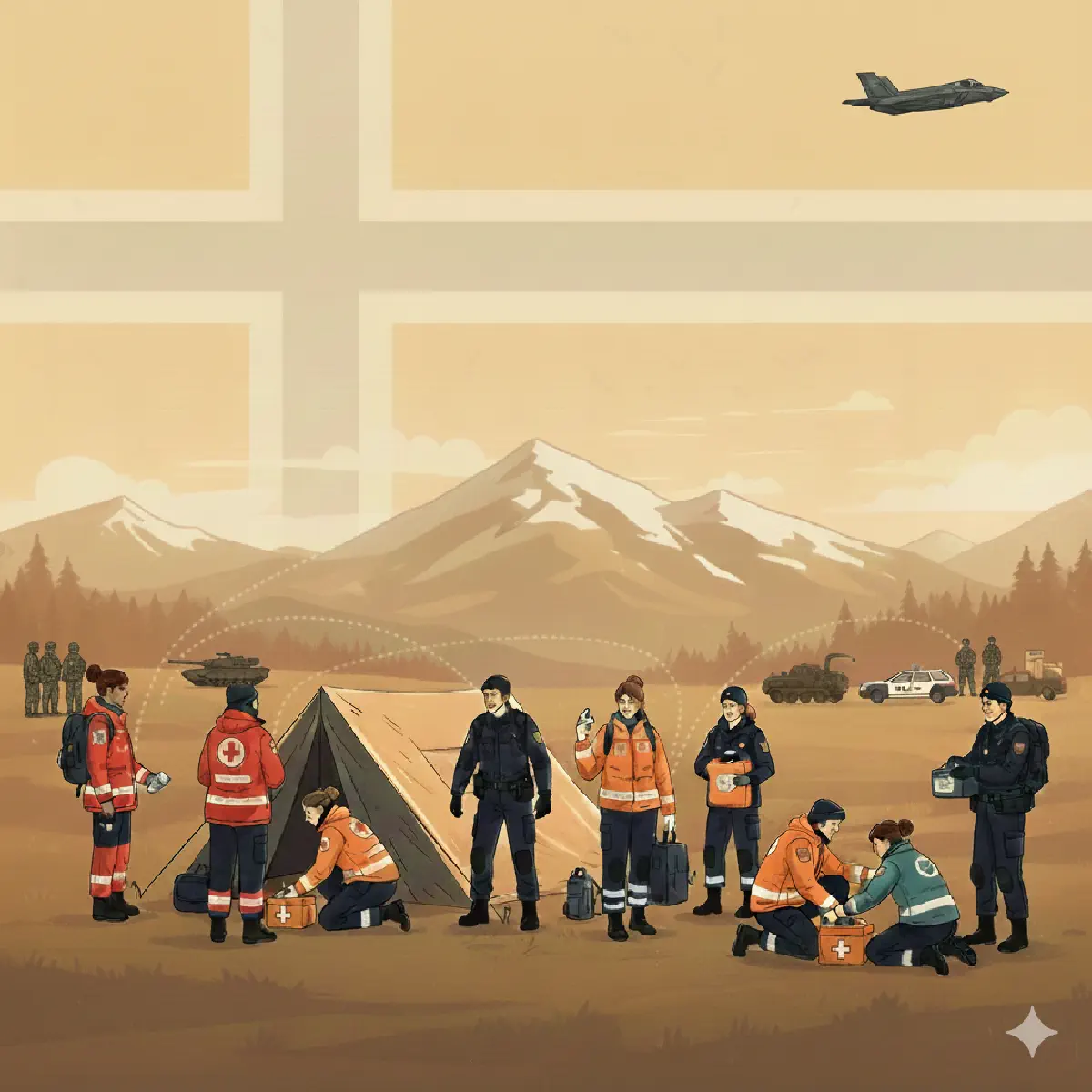
Norway’s defence depends on well-functioning civil-military cooperation within the framework of total defence. The voluntary sector represents a significant but underutilised resource in this framework.
On Coordination Requirements#
Knowledge of each other’s resources and joint training is a prerequisite for effective cooperation. The report recommends that relevant authorities examine how voluntary emergency organisations can be further included in various coordination arenas at central, regional, and local levels.
On Crisis Escalation#
The report anticipates increased voluntary initiative and effort if a security policy crisis or armed conflict were to affect Norway. Planning should account for increased participation of voluntary initiatives, and consideration should be given to how this should be handled within the framework of international humanitarian law.
On Legal Considerations#
Regardless of how voluntary emergency organisations are included in Norway’s total preparedness, Norwegian authorities and the Armed Forces must take into account legal obligations and the voluntary organisations’ independence, characteristics, and role.
Recommendations#
The report identifies several areas requiring further attention:
| Area | Recommendation |
|---|---|
| Coordination | Examine how voluntary organisations can be further included in coordination arenas at central, regional, and local levels |
| Armed Forces | Examine how the Armed Forces can cooperate with voluntary organisations and help coordinate voluntary efforts in security crises and armed conflict |
| Grey zone issues | Further examine how and who should coordinate voluntary initiatives and resources in different stages of the upper crisis spectrum |
| Legal framework | Investigate how increased voluntary participation should be handled within international humanitarian law |
Context: Total Defence#
Total defence (totalforsvar) is Norway’s concept for coordinating military and civilian resources to defend the nation. It encompasses not only military defence but also civil protection, emergency preparedness, and the maintenance of critical societal functions during crises and armed conflict.
The concept recognises that modern conflicts affect the entire society, and that effective defence requires cooperation between military forces, government agencies, and civilian organisations including the voluntary sector.
The Organisations Studied#
| Organisation | Role | Capabilities |
|---|---|---|
| Norges Røde Kors | Humanitarian assistance, first aid, search and rescue | Thousands of trained volunteers, established cooperation with authorities |
| Norsk Folkehjelp | Search and rescue, humanitarian demining, solidarity work | Technical expertise, international experience |
| Norske Kvinners Sanitetsforening | Health preparedness, first aid training, social support | Nationwide network, health-focused competencies |
Why This Matters#
This report addresses a critical gap in Norway’s preparedness planning. As security challenges evolve and the distinction between peace and conflict becomes less clear, the role of civil society organisations in national defence becomes increasingly important.
The findings are relevant for:
- Government planners developing total defence strategies
- Military commanders planning civil-military cooperation
- Humanitarian organisations considering their role in conflict scenarios
- International observers studying Nordic total defence models
The Publisher#
| Organisation | Role | Standing |
|---|---|---|
| Forsvarets forskningsinstitutt (FFI) | Norwegian Defence Research Establishment | Norway’s primary defence research institution; provides independent research and analysis for the Norwegian Armed Forces and Ministry of Defence |
Access#
Available as open access PDF from FFI (Norwegian language).
Related Resources#
- FFI Publications — All FFI research publications
- Norwegian Total Defence — Government information on total defence concept