Table of Contents
Abstract#
Peer-reviewed analysis of how humanitarian organisations’ dependence on US tech platforms creates fundamental tensions with their mandate for independence and neutrality.
Summary#
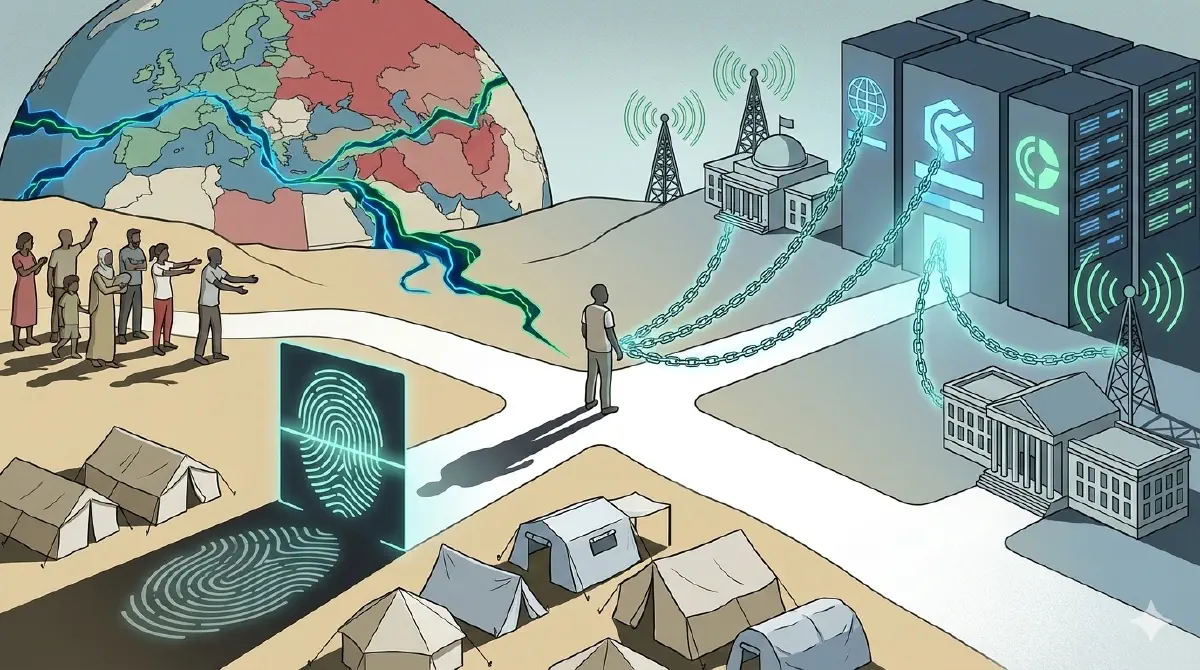
Through cases including WFP’s Palantir partnership, biometric registration standoffs in Yemen, and blockchain payment systems, researchers from six institutions with an ICRC practitioner examine how digital technology disrupts humanitarian space. The core finding: platform dependencies create vulnerabilities that may exceed physical security risks, while “decentralised” systems still operate within existing power structures.
Key Findings#
On the WFP-Palantir Partnership#
“WFP’s operational data provides Palantir with deep insights regarding global food in/security. Their access to this information has heightened concerns among host states about the involvement of a private technology firm with strong ties to the US security establishment in sensitive humanitarian work.”
And quoting Palantir’s CEO directly:
“The core mission of our company always was to make the West, especially America, the strongest in the world, the strongest it’s ever been, for the sake of global peace and prosperity.”
The authors note this mission statement is “at odds with core humanitarian principles, namely those emphasising neutrality… and independence.”
On the Yemen Biometrics Standoff#
WFP suspended food aid when Houthi authorities refused biometric registration:
“WFP’s decision to suspend aid in this case set a critical precedent – it was the first time that a humanitarian organisation had withdrawn assistance in response to local resistance to the use of digital technology.”
The Houthis’ objection was explicitly about sovereignty:
“They refuse the enrolling of beneficiaries in a biometrics programme because it is counter to national security… the collection of biometric data by WFP is part of an intelligence operation.”
On Digital Dependencies and Cyber Risk#
Massimo Marelli (ICRC) contributes a section on how humanitarian organisations become collateral damage in great power cyber conflicts:
“By depending too much on the tools, systems and networks used by one of the actors involved in the ‘great power’ competition in cyberspace, a humanitarian organisation runs the risk of going against the logic of the security rules and principles.”
He draws a physical analogy:
“Just as a humanitarian organisation could be the victim of a rocket attack on a military base if it had its office physically located in or near the base.”
On “Parasitic Sovereignty” and Function Creep#
Stephan Scheel introduces the concept of “parasitic sovereignty” — how digital systems built for one purpose get repurposed for state control:
“Function creep is part of the modus operandi of sovereign power… The parasitic nature of sovereign power shows itself most vividly in the context of the execution of deportations.”
He documents the QMM system in Germany — software built to manage refugee accommodation that was repurposed to track individuals for deportation:
“Social workers suspected that the immigration authority office had used the QMM system… to check if the person they were looking for was present or absent.”
On Blockchain’s Failed Promise#
Margie Cheesman (Oxford Internet Institute) analyses blockchain in humanitarian payments and finds the sovereignty claims exaggerated:
“Despite concerns about anarchic, borderless, revolutionary change, humanitarian organisations are incorporating blockchains into geographically specific sovereign structures of political and financial authority.”
And on corporate capture:
“There are unresolved questions about how far these partnerships facilitate tracking and profit, even when sensitive beneficiary information is not recorded ‘on chain’.”
The Four Conceptualisations of Humanitarian Space#
The article offers a useful framework for understanding “humanitarian space”:
| Concept | Focus |
|---|---|
| Agency space | Humanitarian orgs operate neutrally, distinct from military/political actors |
| Affected community space | Centres rights and protection of crisis-affected people |
| International humanitarian legal space | Focuses on IHL obligations of warring parties |
| Complex political, military and legal arena | Emphasises that humanitarian needs arise from dynamic interplay of actors |
The authors argue digital technologies disrupt all four conceptualisations.
Power Over vs Power To#
The forum proposes a critical distinction for analysing digital sovereignty:
“The analyses of digitisation and sovereignty in this forum position the distinction between power over and power to as an urgent consideration in the governance of humanitarian space.”
Classic sovereignty debates focus on power over territories and populations. The authors argue for recentring around power to:
“How humanitarian organisations can arrange their digital sovereignty in ways that serve affected people and thus the humanitarian mission, rather than allowing technology to merely increase their (or their contractors and collaborators’) power over those people.”
Why This Matters Beyond Humanitarian Work#
This analysis applies to any organisation considering partnerships with major technology platforms:
- The Palantir problem — When your operational data becomes intelligence for a company with explicit geopolitical missions
- The biometrics precedent — Host countries may refuse digital systems on sovereignty grounds
- The function creep risk — Data collected for legitimate purposes can be repurposed for state surveillance
- The blockchain reality check — “Decentralised” systems still operate within existing power structures
- The dependency trap — Using the same infrastructure as geopolitical actors makes you a target
The core question the authors pose applies universally:
“How can organisations avoid co-optation by commercial technology partners who seek power over markets through their proofs-of-concept in humanitarian space?”
The Contributors#
This forum brings together an unusually strong group:
| Author | Affiliation | Contribution |
|---|---|---|
| Aaron Martin et al. | Tilburg TILT | Introduction and framework |
| Sean Martin McDonald | CIGI | Analysis of sovereignty definitions and paradoxes |
| Massimo Marelli | ICRC | Digital dependencies and cyber risk |
| Margie Cheesman | Oxford Internet Institute | Blockchain and humanitarian payments |
| Stephan Scheel | Duisburg-Essen | Parasitic sovereignty and function creep |
| Huub Dijstelbloem | Amsterdam IAS | Sovereignty experiments and conclusion |
Access#
Read the Full Article (Open Access) →
Available via PubMed Central. Also accessible through Taylor & Francis with DOI: 10.1080/14650045.2022.2047468
Related Resources#
- Handbook on Data Protection in Humanitarian Action — The ICRC reference work, co-authored by Marelli
- Tilburg TILT Research — The lead research group
- Centre for International Governance Innovation — McDonald’s institutional home